

S1E5 – Composed Dog, Confident Owner: The Training Philosophy That Works
In this episode of the Find Your Challenge podcast, Shawn Stringham shares a thoughtful conversation with Maddie Meacham of Cornerstone Dog Training, centered on the journey of training his golden retriever, Mitty, and what truly defines a well-trained dog.
They explore the difference between simple obedience and true composure, emphasizing the psychological side of dog training, the importance of socialization, and the critical role owners play in shaping behavior. Through personal stories, Shawn and Maddie illustrate how effective training strengthens trust and creates a more balanced relationship at home.
The discussion also dives into the emotional and behavioral challenges faced by both dogs and their families, highlighting the need for patience, leadership, and advocacy throughout the process. Maddie shares the philosophy behind Cornerstone Dog Training, focusing on family-centered methods and building lasting partnerships.
At its core, the episode reflects on dog training as a transformative investment—one that requires consistency, understanding, and commitment, but ultimately leads to harmony, confidence, and a stronger bond between dogs and the people who lead them.
Your challenge is waiting. Let's find it together. Subscribe and join the Find Your Challenge community.
Podcast Transcript
Shawn Stringham (00:13.678)
Four weeks old, golden retriever, Instagram perfect puppy. We were toast. But let me back up. It started with Stephanie Reed and her dog, Winnie, on Instagram. Gorgeous golden retriever living her best life. Melissa and I couldn't look away. Then we saw Mitty and we were done. But Melissa had one condition. Mitty would be a well-trained dog. Not just housebroken, not just sits sometimes, a lights out, competent, composure-driven partner.
We've owned dogs for 30 years. We thought we knew what we were doing, but here's what we learned. There's a massive difference between a good enough dog and a dog you can trust completely. Today, I'm talking with Maddie Meacham from Cornerstone Dog Training about what it takes to build that partnership, how composure beats commands, why professional training isn't just for problem dogs, and how MIDI went from sock-stealing chaos to the most competent dog we've ever owned. If you love your dog but wish they
We're just a little more reliable. This episode is for you. This is Find Your Challenge.
Shawn Stringham (01:24.034)
Maddie, welcome to Find Your Challenge. Thank you so much for being here. We really appreciate you being a part of the show. It's gonna be awesome. We're gonna have a fantastic conversation. We'll see how long our other guest, Midi here, can hang in with us. He's been here and he's killing it, but he's little bit, getting maybe a little bit antsy, but we'll be okay. Before we get into the training philosophy of Cornerstone and for you, I wanna just tell a little bit of the Midi story just to kind of get people there.
Thank you. I'm excited to be here.
Shawn Stringham (01:52.546)
because I think a lot of dog owners will really kind of relate to how this happened. So Melissa and I have been married for 30 years, 30 plus years, and we've always been dog people, right? We currently have another dog, Scout, who is 10 years old and has been a fantastic dog for us. But if we go down the line, we've owned Cassie, Abby, Meggie, Sadie, Panda, Cinnamon, Simon, Cisco, and Ziggy.
So that goes back to when I was in kindergarten. My first dog ever was Cassie and she, Cassie lived until I was a sophomore in college. So we have been doing people. That's a big, it's a big deal. It is a big deal. Like. Adolescents. Through my adolescence, through my adulthood, I love dogs. I think they add a huge element to personal life as well as to family life.
Part of your...
Shawn Stringham (02:47.382)
And I've always kind of felt like we did okay, right? And that we've been experienced dog owners, like all of our dogs for the most, yeah, all of our dogs have lived long lives, like 10, 12, 13, 14 years. So 19 years for Cassie. that was, was, I was 23 when she died. But as the story goes, Melissa was following Stephanie Reed on Instagram of the Salt Project.
And she has this gorgeous golden retriever named Winnie, right? And so Winnie started having, Winnie's living her best life. And then Stephanie started posting photos of the litter that came through, right? And all of a sudden she sent me a photo of this litter and we kind of got sucked into this one named Lucky. So, this was, Lucky was the initial three or four week old golden retriever puppy.
I think we have that photo, Chloe, if you wanted to pull that up. So that was Lucky the day we brought him home. But there's also the Instagram photo of what posted when Niddy slash Lucky was just like brand new. Anyway, so shout out to Stephanie, who's actually gonna be a guest on the show at the beginning of the year. So we're gonna talk about some of the stuff that she has as well. But as we got into it, we...
we kind of initially thought we were over dogs because not well, because we had Ziggy, Scout was 10 years old. We're about to be an empty nest. We've got just a junior in high school as our last kid, right, Peter. And as we went into this, it's like, okay, we're not gonna get another dog for a little while. And this animal came into our lives and here we are with a new dog that goes and two new dogs that goes along with that. So.
But the deal was with Melissa, and this was a long setup, is that this has to be a well-trained dog. She, with all the other dogs, like they're good, they're not, they weren't great, but she wanted something, a dog that was just like perfect, for lack of better word, right? Like, harmony, that's a great word, right? There was harmony. And so I want you to start talking about, a little bit about the
Maddie Meacham (05:00.524)
harmony between heart
Shawn Stringham (05:09.452)
difference between a good dog, right? And a well-trained dog. as someone, you're with Cornerstone Dog Training. We should start with that. They're fantastic training organization. You have been our trainer. And when I say our, like you've trained Melissa and I and the dog. So that I think that's an important thing to do, but like talk about the difference between being a good dog and a well-trained dog.
Yeah, so good dog kind of has a few different meanings in people's brains, right? Yeah. Sometimes we think of good dog kind of like morals, which is kind of a different tunnel to go down if we were to write on that. dogs think differently than we do. But some people call a good dog one that isn't causing problems. Right. Right. They're not doing things on command. They're not being obedient, but they're not causing headaches. Right.
And so they're just generally a good dog. And so that's kind of what I consider a good dog versus a well-trained dog. And then also the other element of a good dog is a good dog genetically, because really we've, there are instances where dogs are not bred well, not from breeders, just there's a lot of dogs that come from rescues down in the lower States that are feral dogs that aren't genetically sound. Right? So that's kind of the three differences between a good dog.
But generally people are talking about the good not causing headaches. Right, right. Still chewing on things or bringing socks, things like that.
Yep, we still do that by the way. That's still one of our favorites. He loves to, he is the most opportunistic sock dog of all time, so.
Maddie Meacham (06:50.22)
But, so that's kind of the difference between like a good dog and a well-trained dog is one that we kind of talk about the word harmony. Where you have this understanding that the dog understands what the lifestyle looks like. They understand the routine of the home. They understand what their role is so that they don't have to worry about it. of eliminates that anxiety when they know that they don't have to be in charge, that you have got it under control and that you're the leader. And so that's kind of the difference between a well-trained dog and a good dog is that there is.
a sense of team, right? That we're working together as a family to have this dog in our home and there's no issues with understanding what the boundaries are in the home.
Fantastic. What, as you, I mean, you kind of mentioned this a little bit, like, in harmony of the lifestyle, like talk more about that, like when it comes to about like travel and guests and freedom and the confidence of having this, having the dog be a part of the overall life.
Yeah, so there's a lot of different things that people consider with good dogs and well-trained dogs and the harmony that you can have. One, like you said, is travel. You don't have to worry about when you do need to have them kenneled or have them be watched by someone. You know that they're going to have a routine. Even if that routine isn't the same at that, the person watching them, you know that their behavior is predictable because they understand how to be composed. Right, right. And so then there's also the element
of the anxiety that you might have when someone comes to the door, you're not stressed. Right. Having to handle the dog and making sure that they're put away or opening the door just a little crack, right? Right. And so there's this freedom that you have that you don't have to worry. You can feel that stress just kind of start to melt away. And that's why we really enjoy teaching families and it's not just, okay, here's your dog or we'll teach him one or two tricks, but it's all together.
Shawn Stringham (08:32.142)
about.
Shawn Stringham (08:53.036)
And I think as we got into the thing, the thing that led me and I really enjoyed about the cornerstone method is the fact that the whole idea of composure, right? Of being able to maintain composure and that really it's like sit and stay, right? Or sitting down like our commands, but it's not lifestyle, right? Like it's, it's just talk more about composure, right? And like what that means for the dog and what that means in terms of integration into the family.
Yeah, so composure is the state of being calm and self, kind of that impulse control. Right. And so really the difference between teaching a sit and a stay or a down, we teach those things for sure. Right. The commands are a kind of a way to the composure. Right. And so the goal is to be able to do it without the commands as well.
We definitely focus on commands, but the composure training is the important element because if you have a dog that is riled up and can't control their stress, then they're not going to be listening to you because they physically can't. Right.
Right, and so talk about that stress. We're seeing some stress here. He's been on his pedestal here a little bit longer than we've been rolling, so he might be getting a little tired. the arousal curve and the elements that go along that, if someone's watching or interested, what should they be looking for in kind of talking about that overall arousal curve?
Yeah, for sure. So the arousal curve or stress curve is where we kind of watch a dog's behavior and you can kind of see this in humans too, but with dogs, it's the very top is biting, barking, lunging, right? Right. And it can be mouthy. It doesn't have to be like aggressive lunging with puppies. It's mouthy. And then we have drooling, we have shaking and you can see his nose is a little bit more wet than it normally is. So he's not necessarily drooling, but he does have that salvatory gland going.
Maddie Meacham (10:57.174)
And then also the, sometimes dogs will shake. I mean, a common one that you think of is like chihuahuas. They're nervous, they're shaking. And then heavy breathing is one. So you'll notice that Midi was heavy breathing, licking lips, that type of thing. they're all very physical cues that you can kind of see. It's how you become a dog whisperer. If you can see where a dog kind of stands on their composure. And so where Midi's getting a little bit more,
He's going after the little thing that you dropped, but as he's getting more...
Stress is the word that we use, it's not like stress that we think of where it's anxiety and they can't handle it. But it's a physical reaction of unsettlement, right? Right. And so he is trying to work on being more composed. And he's been here for probably 30 or 45 minutes on his little pedestal here. And so he's been working on it. And so that's kind of what we do is he can't be composed if he's constantly
or he can't be obedient if he doesn't feel settled in his brain, right, if there's stress. But it's cool because the more that they learn how to be composed, the more impulse control they have, right? And we think about composure and some people worry about making them do something, but really they're designed to work, right? And so imagine having all of this energy of trying to find
something to do, they need to do something, but we're just giving them the freedom to be, but they want that structure.
Shawn Stringham (12:43.394)
And I think one of the amazing things that I have learned from Midi is that you just said that he loves to work. Like his favorite thing is to train, right? Like he, he's excited. Like when we get the tools out that we're going to work on training, like he lights up as opposed to it's just like a teenager with that is left with too much time on their hands. Like they get into trouble. You know what I mean? And so we have found like if we're, if we don't train him.
every day, like that day goes poorly for him. Yeah. So maybe talk a little bit about that, about like what their, the psychology of that, of the dog and how that works. I'm assuming it's just like a teenager or like the rest of us. mean, if they're not actively engaged in good things that they're going to find bad things to do, right?
I mean, it's kind of like all of us, like you said. And so when we're giving them a job and you see on Google all the time, like give your dog a job. And a lot of people think, they need to go get a water bottle from the fridge for me. That's not exactly what we're talking about here. We're talking about more long-term commands, like a place command. This is kind of what Midi's doing right, is a where we're asking him to be on a defined space that has boundaries and he knows he needs to stay on it.
And so what that does is it gives him structure. gives him something to think about. So can see, you can watch his face. He's processing. He's like, this is unusual. I haven't been here before. This is new. He's trying to work himself down. We might see in a few minutes if he does like a big sigh, like he's, he's completely calm. And so the psychology of it is, that the more that he has to do the boundary and stay there, the more that he, his brain learns to have that impulse control. And so this kind of has.
a collateral effect on how he is off of place too. Because then when someone comes to the door, he's not reacting because he doesn't feel that need to react immediately to whatever, to the stimulation that's there. And so a place command, a composure command, right, is what we really like to see. And so you can do this with sitting down. Sit is a little bit harder because it is more of an alert stance, right?
Maddie Meacham (15:01.25)
but like a down or a place, if you're teaching them how to stay there until they are released, then they are practicing that impulse control because they understand, this is what I'm doing right now.
Yeah. So as we kind of get ready to transition here, do you often see like back to the dynamic between Melissa and Sean, as we were coming to Cornerstone of like one, as a family is coming, like you have different levels of people who are committed to the process. Like is that, is that part of the, you're the miracle worker as a trainer to kind of manage those expectations from, of the humans as much as the dog, right?
Yeah, we do have a lot of, I've had a handful of people that come in that are not on the same playing field, like on same page. And more often than not, what it is is that dogs understand that when mom, and this is usually the circumstance we find ourselves in, when mom's at home with kids and dog, they're able to get away with more because mom has her hands full with kids and meals and things like that, that the dog can kind of sneak away. But then when dad gets home and kids are home from school, there's...
Right?
Maddie Meacham (16:08.878)
more eyes on the dog and there's less chance to get away and do bad behaviors. And so that's when we kind of see a disconnect where the mom's like, this is what's happening at home. The dad's like, I really don't see it. And so there's not really the same level of commitment. And so it's kind of important, actually it's really important for everyone to be on the same page. And that's going to be involved in the training because it is something that you're doing together. And dogs are great.
on off the back here. There we go. There we go. Way to settle in.
Dogs are great at bringing families together. Just to kind of call back to your comment about being done with animals. I firmly believe that dogs come into our lives at certain points for very specific reasons. And so it's important just like they come into our lives that we are on the same page. I'm both getting a dog and training, which I think need to be
One.
So we had just got Midi and we ended up, we were working on the puppy training stuff and we took him on a road trip and we thought that would be in our infinite wisdom a good idea. it worked out pretty well. was five or six weeks old and we took him 14 hours in the car down to Long Beach, him there and like.
Shawn Stringham (17:40.652)
Lots of people, mean, when we met, that's one of the things like, he needs to be well socialized. He has to be willing to go and do crazy things because we do crazy things all of the time. And he did a really good job. Like it was a very positive experience overall. How important are experiences like that early and the kind of talking about the socialization process for.
Yeah, so it's a little bit different than what we think about as humans. Right. So with kids, we kind of stick them into a play group and we say, figure it out and have fun. Play nice. Right. Right. To a dog, they're going to react one of four ways, right? So they're going to react fight, flight, avoidance or acceptance. And depending on the circumstance, the situation, they're going to choose one of those. And more often than not, it's not one that we prefer. Right. Right. And so the big key there is to actually start at home.
with scary noises, with getting a soup can with nuts and bolts in it, not shaking it super hard, but I like to just spin it a little bit. It makes a little whirring noise. And just finding noises that they're uncomfortable with and practicing having them work through their stress curves. So having them be on place or in a down or just dealing with it because exposure without composure is not socialization. It's just...
showing them that things are scary, right? And so we have to work them through it. so situations like that where it's a younger age is really good if they have those skills that you've taught them before, right? And it's not detrimental to take them to the beach when they're so young, but it's that you are aware of where they are on a stress group. And so if you start noticing, hey, they are reacting, and sometimes we think of reactivity like aggressiveness.
Right.
Maddie Meacham (19:29.442)
And they're not the same necessarily, but it's the every time they see a person or a dog that they get really excited. And they start jumping on them. They start mouthing them. They are barking just because they want to be pet, things like that. That's reactivity. And so that's not really good for their composure training if we're taking them out and then just letting them run free. Right. Right. So that's kind of the difference between taking them to the beach and being monitoring them and helping them understand what the command is that you're wanting them to do or
if they get too excited that we're gonna start calming down for a bit. We're gonna take a minute, we're step back and work on that composure training.
So let's talk about Chaos to Calm. That's the class that we were in, right? It's an eight week program. come in, there's four sessions, live sessions that we're doing. And obviously we're doing a ton of work at home, but just talk through that process of what that class looks like and what you're teaching.
So our in-person training mirrors our online program. So we have an eight-week course, the Chaos to Calm course, and at your home the first week, then you're here one-on-one with us. So you really get that personalization when you're in person. And what happens is that you get to watch your dog transform, which is such a cool experience because you get to watch them, but you also get to watch yourself. I don't know if you felt the same way that I did, that I was like, it changed me.
as a person. And I got to watch as I understood my dog and I understood myself more too because I started noticing, oh, when I get frustrated, I need to take a step back. And not that I was lashing out at people, but I could, I started to notice. were biting people. I wasn't biting people. It wasn't getting that bad. No, but I got to watch as when I'd get frustrated with him, I could feel myself getting more frustrated. And I realized that I was fueling that. Right. We were both.
Maddie Meacham (21:25.92)
amping each other up and it wasn't, then we were spiraling. And so I watched in my own experience that I learned how to see those cues through him and I could step back and not take it so personally. Because we kind of take dogs like we do child rearing where we take it personally if they're not behaving well.
So I wanted to talk about that because I have noticed that, right? dogs have a person or people? Like they feel connected. Like I feel like Midi and I have a great connection. I feel like Melissa and Midi have a good connection, but it's one of those where like I can sense where he is and I feel like he can kind of sense where I am, right? And then we can kind of meet each other there. Like I'm back to the point of like...
dogs come into our lives for very specific reason. And I totally 100 % agree about that as well. Like, how does that, and just talk about that understanding. Like, how does that happen? Like, how is that working for a dog? Like, what makes dogs great that way?
I think dogs have a, well, one, they are really engaged in what we are doing. Right. They want to know they're interested. It's kind of the difference between cats and dogs, right? Right. But then also they go off of context. They don't understand our language. They can learn words up to 250 words, but it's not sentences. Right. He can't tell what you're saying besides the words that you have given action to, right? So like place he knows what that means.
but he's not understanding your conversations, but he can sense what's going on because he's been around you a lot. It's all about that connection. So we really believe in balanced training where it's a healthy balance of both connection and correction because you can't, he needs to know that you're gonna advocate for him. So he needs to know that you're gonna lay the law down. And so part of that, to answer that question of does he truly know his people? Yeah, he does.
Maddie Meacham (23:26.594)
because he knows the baseline. knows he's around you a lot. He understands the context. He watches his pattern recognition. And so he understands when you're stressed, you're having a good day, things like that. And they pick up on that real quick.
He's amazing at eye contact, right? Like, I mean, he's like, as they come in, and I feel like that's been one of the things that maybe has been different with Midi over some of the other dogs that we've had in the past that we mentioned is like, he seems, and I don't know if it's the breed or the training or, but like we come in the room and it's like, he's looking at me at the eye, like, what are we doing here? He's ready to go. He's ready to go, yeah. Like is that, is that,
Is that one of the things like that awareness is part of that chaos to calm training that you're building?
That is something that we work on for sure. Some dogs have it more than others, but I'd say Midi has an inclination towards it in general. He wants to know what's going on. He wants to know what's working and what he needs to do. And so I'd say that is something that Midi's really good at and something that he is innate in him, but that's something that we work towards. In fact, that's one of the first things that we do in egg one is teaching dogs that don't know how to do that.
eye contact because focus kills chaos. And so if he's focused on you, then everything else is going to kind of melt away.
Shawn Stringham (24:51.788)
And talk about some, in that chaos to calm course, right? We've talked about composure. We've talked about, you know, obviously sit is a thing, right? Weight is a thing. Healing is a thing. What are some of the other key pieces of that training that are the building blocks of a fantastic family animal?
Yeah, so those building blocks really consist of the commands, right? Because we can teach composure. can't tell a dog, hey, calm down. We can't really explain what that looks like to them. And so the way that we do that is we teach them these commands. We show them there are boundaries, there are all these rules, because as we go along, we're going to teach them how to focus through these commands. And then along the way they're going to become...
something better to unleash their potential. That's kind of one of our big mottos is to focus, become and unleash. And so we see that in our own lives as well, right? I'm sure you've seen it with goal setting. And so that's one of the big things that we teach people as well. And so with the dogs though, they get to watch it. I think they also get to watch it, their humans grow too. And so there's a very big bonding aspect to the training because they are
learning how to do these commands. And so we're doing, like you said, the sit, we're doing downs, we're doing, we don't teach a stay command, which is a little bit different. We teach all the commands have a implied stay with it. So if I ask him to be on place or if I ask him to be in a down, he's expected to stay there until I release him. And so that's kind of element of impulse control is that you can't just sit and then walk away and then.
It's he does the thing and then he's done. Because he'll do a trick for a treat. Right. Pretty much any dog would. Right. But the difference is that we are teaching how to, to hold it and to have that impulse control and to be focused on what we're, we're teaching him. Because then when push comes to shove and it's a safety concern when you're out on a walk or a hike that he's able to do it.
Shawn Stringham (27:04.49)
The, are, there, what are some of the next steps, right? Like, so middies pretty good at some of these things. He's not great at all of them, but like.
I'd say it's re-
You know, we think he's great, you like, talk about, you mentioned this a little bit, but like, talk about the owner training, like your perspective as a trainer, right? Sean and Melissa, let's say are walking in with new puppy. Like you're training us just as much as you're training the dog. any good stories around that in your experience? You've been training for five or six years now is what you said before. like is that, how does that.
Is that part of the excitement for you as a trainer? do you have any like, do you have like anything funny or good stories that go along with that? Yeah.
So I'll tell you that first of all is that training is not necessarily, you don't necessarily have to be a dog person. You have to be a people person. And I really enjoy, the dogs are a bonus for sure. I love dogs, but it really is neat watching the people because dogs get it. They always do. I mean, our boarding trains are three or four weeks long. pick it up really fast. But what's really neat is to watch the humans grow and
Maddie Meacham (28:22.836)
the their owners and they get to see and and so it's really fun to see the excitement you guys were a great example of that I love to seeing I knew your trainer always knows if you're working or not there are things that we see but I loved how excited you guys were to follow up and show me what he had been learning and I think one one instance my favorite instance was
a dog named Cookie, who was also a golden retriever, but was aggressive with their owners because it was a very, we call it pack drive, without getting into the science of it, is where a dog relies heavily on the totem pole, who's in charge. And to these owners, they wanted to love on Cookie and they did, but Cookie didn't see that as leadership. She saw it as...
I'm in charge. right. Because there wasn't any leadership cues to dogs. And so what happened was that they had to get a laundry basket to like, when she'd get aggressive, they said they felt like circus performers, like with a chair or the laundry basket, like pushing the dog away. Right. Because she was biting at them. Wow. And they just, had, they couldn't live like that anymore. And so was so cool to see Cookie who was going from like, she would look at you like this and to having to,
lock her in a room with a laundry basket until she had calmed down to this dog that was calm and just neutral around other dogs and other humans and happy to be around her owners and just the dog of their dreams. And so it was so cool to see, you typically don't see golden retrievers that are really aggressive, to go from that to one that they could actually be around. They couldn't pet her.
Like it got to the point where they couldn't be around her. They were kind of living in separate areas of the house. that's my favorite is when I get to see dogs that are particularly difficult go to, from that chaos.
Shawn Stringham (30:36.334)
Yeah. And Mitty's been very, like, he's been pretty chill. Like, I think that it's one of those where, he's just a pretty good dog, you know what I mean? Overall. But do you have an experience with just, like, a total success story of, a dog that maybe was aggressive or totally unruly or whatever and has gone through this? Like, there's a chance for any dog at any age to be trained, yeah? Yeah.
Um, one, there's one that I'm thinking of that's not my story. Um, so you'll have to ask Jason about it. But, uh, the one that I'm thinking of is a dog named Pearl and she was six months old when I got her. Um, this one was a Borden train. Um, so those ones are a little bit easier for me to see the success stories. Right. Um, it's a bigger for me because I'm the one running the work all the time. Um, but she was a, this little dog that had never had a leash on, had never.
Yeah.
Maddie Meacham (31:33.506)
been in a crate, had never had any type of boundary put on her at all. She'd been free fed, like all the things that we don't recommend because we want to set boundaries. And I put her in a crate and I really thought that I was going to get bit the first four or five days. She was very nervous. She was not eating very much. I had to like really work with her to get her to that point. Excuse me. And she was lunging and things like that.
And after a while, I kept just working with her and working with her and she started to understand those boundaries and see, like I let her out and she just run to her place. And then it started where she really began to want to be near me and want to just be involved in what I was doing. And so it went from this dog who had no boundaries, had, he was barking, was
having accidents in the house every day. To this potty trained dog that would go in a potty spot. And we were able to work with her. That's amazing. And it was so fun to see. And she actually came back and did some boarding with me and she was just so excited to see me. And she just came over and we were interacting and she wanted to just sit by me and be pet. And it went from this dog who was going to bite me. Right, right.
this dog that understood boundaries and understood that I was going to advocate for her if and she didn't have to worry about what she needed to do, I'd always tell her.
I mean, talk about that a little bit about just leadership. Dogs are looking, because I feel that like under the heel command, right? Where it's like, dogs will know a couple of inches makes a difference. It does, right? Like, who's in charge of this situation, right? Is it the dog or is it the human? And kind of the importance of that, right? Of like letting the animal know like,
Maddie Meacham (33:27.346)
yeah.
Shawn Stringham (33:41.55)
I'm the pack leader.
Yeah, and there's nothing that's that's mean sometimes people think about it that way right they think You're trying to be the alpha you're trying to be right dominant and yes, you are but those aren't necessarily mean words sometimes culturally rice are Negative connotations, but really what it is is that you are showing them that they don't have to have the stress of being the leader right? Because can you imagine trying as a dog trying to take care of this? Family of humans right won't listen to you. Yeah, and so that's really
The importance of leadership is that you mentioned with that heel. If the dog is walking a little bit ahead, sometimes we think of it as like giving them a little bit of freedom, but really what it is is they're pushing that boundary and saying, okay, so I am in charge. I do need to take this role, have this mantle on me. And so a heel can really, where they're side by side with you, walking in step, they understand that you will handle any situation, any dog that comes up, any human.
you will go up to bat for them. And so that's a big deal with any kind of dog training is leadership.
So Middy's a great dog now. I am thrilled with how he's come into our life. We do a lot of things together. Our family does a lot of things together. We have all of our kids love him. He's done a really good thing and he's integrated well with Scout. Like they're really fun together. And as he's grown, that's been a great thing. So the title of this podcast is Find Your Challenge. And this has been a challenge.
Shawn Stringham (35:16.878)
It is a challenge. is, it's discipline, it's goal setting, it's action, it's all of those things, right? And it's a challenge that changes the animal, it changes the family as much as anything. And you had mentioned this as well, but like, I have found myself thinking way more about my own personal composure. And we talked about that of like being able to calm yourself and to be able to like...
notice where you are and like how that goes along.
Just, mean, this is a kind of a loaded question, like, tell me what you like having a great dog. How does that make your life better? Like what, like there, cause it's an investment. It's an investment. it's, it's a, you know, there's books that you can read on training. There's YouTube, all of those kinds of things, but doing this to have a great dog, like what is the ROI on the investment of doing this? Right.
Fizz 0100.
Maddie Meacham (36:16.654)
So the biggest thing is that for me anyways, and I'll talk a little bit about my story, is that I didn't realize how much anxiety I had around my dog. I'm not a very anxious person in general, but with my dog, he was very vocal. And we have renters in our basement and I felt like every time that he was parking, we were losing income. Like we were losing our renters. And he had gotten this habit of every time that a car door would close,
he would bark because he knew that someone was gonna pass our back door. And so there was, he'd conditioned himself to get reactive every time he heard a car door closed, whether it was at our house or another house. And so I found myself after training, I didn't realize it, that every time I heard a car door close at my house, my anxiety would start to go up. And this was after training. But he was no longer barking, but I could feel it. And it took me a while to get out of that. And I realized that there were some anxieties that I didn't...
know that I was having, because he is a good dog, but he was reactive. And so I didn't realize that I was having these feelings and this stress until after the training. think you had mentioned to me earlier that you didn't realize the degree of training that you were getting into. That you didn't understand how different life would look. You knew what you wanted. You knew you wanted a good dog that you could take anywhere, but you didn't understand
Yeah.
Maddie Meacham (37:43.458)
the magnitude of how good that is.
It's, I mean, it sounds kind of silly, but it's a lifestyle of training. It is. Like you're, I'm thinking like, cause we're moving around the house. Like he's, he, he is not like on command every time. he, he's out wandering the yard, but like we are regularly like, like every time we go on a hike or we go around or we're walking somewhere, like we're working those skills every single day. And so has been.
You're in meeting.
Shawn Stringham (38:15.874)
That's been fantastic for us because it also kind of gives us some focus around that as well.
Yeah, you definitely, it's an integration training. So it's not designed to work your dog for six hours a day. Right. Right. But every time they go out to the bathroom, you're going to do a weight command. Right. Or when you are filming a podcast, like this, right? Things like that. And so it's all about integration. And so it's not necessarily that you are working on
doing things every single like every single minute of every single day you are changing the way that you live to be conducive to how he understands right and how he lives and so it's not that we're sitting on place next to him it's that he we're sitting down the end of the day we're having movie night with kids he's on place
He's on place, yeah. That's been a great one. Because in the past, with Scout and with Ziggy and others, it's just kind of like, it? A dog pile, right? And you have the ability to have him come in and say, midi place, and have him just chill there and just relax. And it's really great for our family. Yeah, it's the really fun part. Or you've seen where we've gone to the pool, or whatever, and he's just kind of coming in.
and dogpile.
Shawn Stringham (39:34.764)
And that's the part that's amazed me is that like we're on a pool at a pool deck and there's a water polo game going on and people walking around and he's just as happy just sit there next to me and not have to worry about what is happening in the world. And it's just really very, it's great for me as a human, right? I feel like it's great for the dog as well. Yeah.
That's kind one of those return on investments you were talking about, right? Is that you get to be with him more because more boundaries now means that more freedom later. And so he has that freedom because you know he's not going to go try and rescue someone in the water.
And I think one of the things, and we've kind of had this conversation a couple of times and opened it up a little bit is, we love to go up the canyon. Yeah. Right? Like we, we're, we're mountain people. have mountain dogs. Melissa takes whenever she goes up the canyon by herself. She always takes a dog with her just for safety reasons and various other things. And up on the screen there, you can kind of, you can see there that this is one of the crowning achievements I feel like of place. it's similar to where we've, what we have here is like,
Really, you can put them in place anywhere. Yeah. It's a, it's a, a life changing command. Yeah. Yeah. what we have found, again, being dog people is that there are a lot of really untrained dogs.
As long as there's a boundary, you see something.
Maddie Meacham (40:59.254)
You've figured it out, Sean.
and like, and I, and I think one of the things that you told us and taught us upfront is like that idea of like having to advocate for your dog. And I think that was a massive mind shift for me of like going up the canyon, like we don't need to have a nose to nose, like, we're just friends playing experience with all the other dogs. Talk about that a little bit. Like kind of that mind shift of like.
Putting of advocating, like the human advocating leading for your animal.
One is putting them in situations that you can advocate for them. dog parks are not a great place to be. They're kind of disease-ridden fight clubs because you can't control your dog, you can't control others. And so first of all, I don't enjoy going to places like that.
Shawn Stringham (41:53.39)
Who didn't silent their phone? My goodness. Okay, go ahead. Club.
Yeah, so we don't like dog parks because really and from personal experience it made my dog more reactive because He didn't have to have that impulse control, right? He could react every single time But then also when you're advocating on the trail You don't realize that that your dog is looking to you for that direction and if they're uncomfortable and a dog is coming up and that knows to knows We kind of Hollywood's taught us that that's how dogs say hello, right? But really he can smell
that dog from way across the trail, right? He can smell them coming. And so going nose to nose is kind of the equivalent of hugging a stranger at Home Depot. And so there's a few ways that's going to go. Same with dogs, right? So that fight, flight, avoidance or acceptance. And it's a little bit worse because a lot of times if dogs are on leash while they're going nose to nose, they can't flight and they can't avoid. So it's either going to go to fight or to acceptance.
And depending on how that dog is reacting, depending on how the owner is feeling, there are lots of variables that we can't control. And so a lot of the time when I'm interacting with dogs and I feel comfortable with them going nose to nose, it's usually off leash in a neutral setting. And neutral, I'm saying like in an area that is not bottlenecked where they can't like walk away or feel like they can't disengage safely.
So.
Shawn Stringham (43:27.768)
there people hopefully out there listeners probably one or two at least right you know that might listen to this but someone has a chaotic dog yeah right what's step one for someone who has a desire to no longer or to work on having not having a chaotic dog
Yeah, well step one is calling me for free consultation.
There you go, I set you up for it, so that's good.
So yeah, give us a call and even if you set up that appointment and come and you just ask questions, even if you decide not to do training, we'll put you on the right path. We'll show you some techniques that you can do. But if you, the very first thing I would do if I welcomed like a rescue into my home or a new puppy, let's talk more of a rescue. So if I were to welcome a dog in that I rescued from the shelter.
What I would do is I would do crate training immediately. That's the very first thing. Crate and potty training are more important than obedience because if you have a very obedient dog that they're pooping all over your ass, you're going to have issues. But the crate also is that same effect as place is that it teaches them how to be calm because they can't have, if they're going to have that stress curve, if they're going to be
Maddie Meacham (44:52.226)
stress, they don't have to do anything about it. I mean, you hear about dogs that tear into sheet rock or tear up carpet, things like that. It's because they feel like they have too much responsibility. And so that crate really shrinks it down and it shows you, it shows them that they don't need to worry about anything, that they just have to figure out how to be calm. And there's nothing in there for them to do or push their anxiety onto, like a toy or anything like that. And so that's...
the very first thing that I would do is I would crate train if you haven't already. Now, if you've done that, then I'd put your dog on a leash. Right. Because that is the number one tool that we use is a leash because they look up to whoever's holding that leash. I've had dogs that have been very aggressive, have bite histories, and the second we get a leash on them, I'm holding it. One, I can also correct if they're going to try and bite me, but also they understand that there is a
attack of communication happening when the race goes on.
Right, yeah, great. So with this fine golden retriever that we have here between us, he's nine months old, he's gone through the training, he graduated. I feel like it was a great moment when he graduated. What are his next steps? What should train us, teach us here? What are the next things for Midi and us? Obviously. Gone to Melissa and family.
Obviously, there's the lifetime group classes that we offer. It really just kind of depends on your lifestyle and what you're looking for. I think Midi would be great as a therapy dog, like visiting homes and things. That's just, he's got the personality for it. Not every dog does. Right. And so I think he'd do great with that. But if you're talking about Sean, Melissa and family, I think that your next steps are figuring out if you want to take him with you. Like you said, you went to Moab. Yeah.
Maddie Meacham (46:47.054)
continuing to do socialization and composure training with things like that, trying different games with him. can do... He's almost asleep. Oh, you heard me.
Arousal curve here we go. It only took 45 minutes, you know lights camera action.
But this is new, right? The lights are hot, the microphones, can hear everything. So this is actually kind of that next step that you're talking about, right? We're putting him in a new situation that is very, to us, this is not very new. But like I said, the lights are warm, there's noises from all the technology. He can hear the microphones and possibly the headsets. And so this is a very new situation for him. So it's really pushing that threshold. So you've kind of pushed us through.
threshold to where we want it. And you can continue to do that throughout his life, just like us, right? Just because you graduated high school does not mean that you are done learning. And so there's new skills that you can always teach him. If you want to teach him to swim, you could do that. that's it. You kind of have the skills now because we've taught you how to teach him things. Yeah. That's part of the training is that we don't just teach him things. You guys know how to work with him and know how to teach him new things. And so you can go through and you can kind of
put more under his belt.
Shawn Stringham (48:09.57)
Right. So brag about Cornerstone. Why Cornerstone, the kind of the philosophy behind it, Jason and Laura Lee, right? The trainers, like just go all in. Yeah. And brag about them. give them the biggest plug that you possibly can. Awesome. have been fantastic.
So cornerstone dog training is honestly what sets us apart is that we are a family, right? We really focus on training families because that's who we are. Jason and Lorelei have eight children and so they know how it is to train dogs with a busy schedule, right? It's not designed for people who are single or have just a dog and nothing else going on. It's designed for people that have life.
In a
Maddie Meacham (48:56.886)
happening to them all the time.
Bring him to have life happen all the time. That's a good fit.
And so I, I mean, as someone who did training when their dog was 18 months old, he was reactive. And so this is kind of my story. Obviously he was reactive and he had these big issues of being vocal and chasing after things and running away. And I didn't know what to do. And I tried the YouTube thing. I felt like I was pretty good at handling him and like teaching him things, but it wouldn't stick. I taught him how to do.
a sit command or a place command, but he couldn't do it for long and with distractions or anything like that. And so when I found Cornerstone, it was an investment for me and my husband. We were both in college and both working and trying to make ends meet and we thought it'd be a great idea to get a doc. Right. But, uh, so we decided that it was worth the investment to us and we went all in and it changed my life because I got to see him go through it and watch myself go through it as well.
and Jason Lorelei.
Maddie Meacham (50:06.208)
are invested in your dog's future. Like that's who we are, is that we want to see them succeed, but we want to see you guys succeed. We want to bring families together because dog stress can tear families apart. And so we really want these dogs to truly bring families together and have an atmosphere of harmony. yeah.
Our goal is to help. if again, if you want to come in for a consultation and we will show you how to do things, you on the right path.
Look him up, everyone. It's been fantastic for the Stringham family and for Game On Life Studio. Like he's a studio dog, right? He's a mascot. He comes to events with us. So all of that is because of Matty and Jason and Lorelai and Cornerstone. So website is cornerstonedog.com. Check them out at cornerstonedog on Instagram, Facebook, YouTube. There's a podcast there. We're going to put, hopefully we'll
do some podcasts back and forth with this. First consultations free. Okay. And then it's a couple of different programs. We've talked about the puppy program, talked about chaos to calm, which is an eight week program. And the investment is worth it. can tell you it was, it was a, it's a financial investment with Melissa and I, but it is, you know, if you look at a dog that is going to live 10 to 15 years, like
Yep, is free.
Shawn Stringham (51:47.072)
It's a great thing.
Drop us some closing wisdom on us. just get on your, get on, what do you want all dog owners to know about training and what, period, about what do you want them to know?
that even though we teach commands, that those are the building blocks of how to teach composure, that we're not so focused on being like military, yes, sir, kind of dogs, that we're really focused on them becoming. And that's how we are with our trainers. That's how we are with the dogs, with the families we work with, is we really want them to become and unleash their potential. Like that's really what we were in the business of.
is helping people and dogs grow and have progress. And so that kind of changes the tone of training. And so my hope for everyone that comes across with Cornerstone is that they become someone new, right? Right.
Yeah. So love that. Cornerstone dog.com. We talked about the social media. This been having the opportunity to be with Maggie, Maddie Meacham with Cornerstone dog training and Midi, the Instagram puppy who stole our hearts. Thanks again. Shout out to Stephanie Reed and Winnie for sucking into this golden retriever world.
Shawn Stringham (53:16.83)
It's been quite exciting and then learned to be the most composed, confident, incredible dog that the Stringham family has ever had. And we have incredible dogs, like Scout is an incredible dog and Cisco and Ziggy, all incredible dogs. But I think Midi is at nine months, way further than any of those other dogs have been. Maddy Meacham from Cornerstone Dog Training and Midi, the Instagram puppy who stole our hearts. Thanks to Stephanie Reed and Winnie for sucking us into this golden retrieval world.
and then learn to be the most composed, confident, and credible dog we've ever had. Here's what I want you to hear. If you love your dog, but find yourself saying, I wish I would just, or if only she didn't, that's fixable. It requires work, consistency, professional guidance, but it is fixable. Training MIDI has been one of the most rewarding challenges I've taken on. Not just because I have a great dog now, but because of the partnership we built.
the trust, the communication, the confidence that Midi can go anywhere and handle anything. Melissa was right. Yep, Melissa was right. Every dog deserves to be well-trained and every owner deserves the experience that, what that partnership feels like. If this episode resonated with you, here's what I need you to do. One, subscribe to find your challenge. Hit that subscribe button on YouTube. Follow us on Apple Podcasts and Spotify, wherever you listen.
new episodes every week featuring people tackling meaningful challenges. Two, share the episode, tag a dog owner who needs to hear this. Send it to your friend whose dog jumps on everyone, post it on your Instagram story and tag Game On Live Studio, SQ Stringham, that's me personally, Salt Lake City Midi, SLC Midi, follow Midi's adventures at SLC Scout, Scout still got it at 10 years old and of course at Cornerstone Dog, Maddie and the Cornerstone team.
Follow the pack. Seriously, Midi and Scout have their own Instagram accounts and they're pretty entertaining. At SLCMidi and SLCScout, you won't regret it. Follow Cornerstone Dog Training. Go to at Cornerstone Dog on Instagram, Facebook and YouTube. Watch their training content. See the transformation they create every day. And of course, follow Game On Live Studio at Game On LS on Instagram, TikTok, Facebook, everywhere else. We're serving underserved sports and telling stories that matter.
Shawn Stringham (55:37.826)
Follow me personally at SQstringham on Instagram. I share behind the scenes of goals, find your challenge and life as a founder, dad, and now dog trainer, kind of. Tell us your challenge. What are you working on? What's your version of training MIDI? Drop a comment below, send us a message. We read everything and shout out to Stephanie Winnie's mom on Instagram for unknowingly launching us into golden retriever parenthood.
You're coming on the show soon and we're going to talk about how your content creates connection and community. Stay tuned for that episode. And if you're in the market for an incredible dog training, go to cornerstonedog.com. Tell Maddie that Midi sent you until next time, find your challenge and train your dog while you're at it. Go be great.

Contributor Details
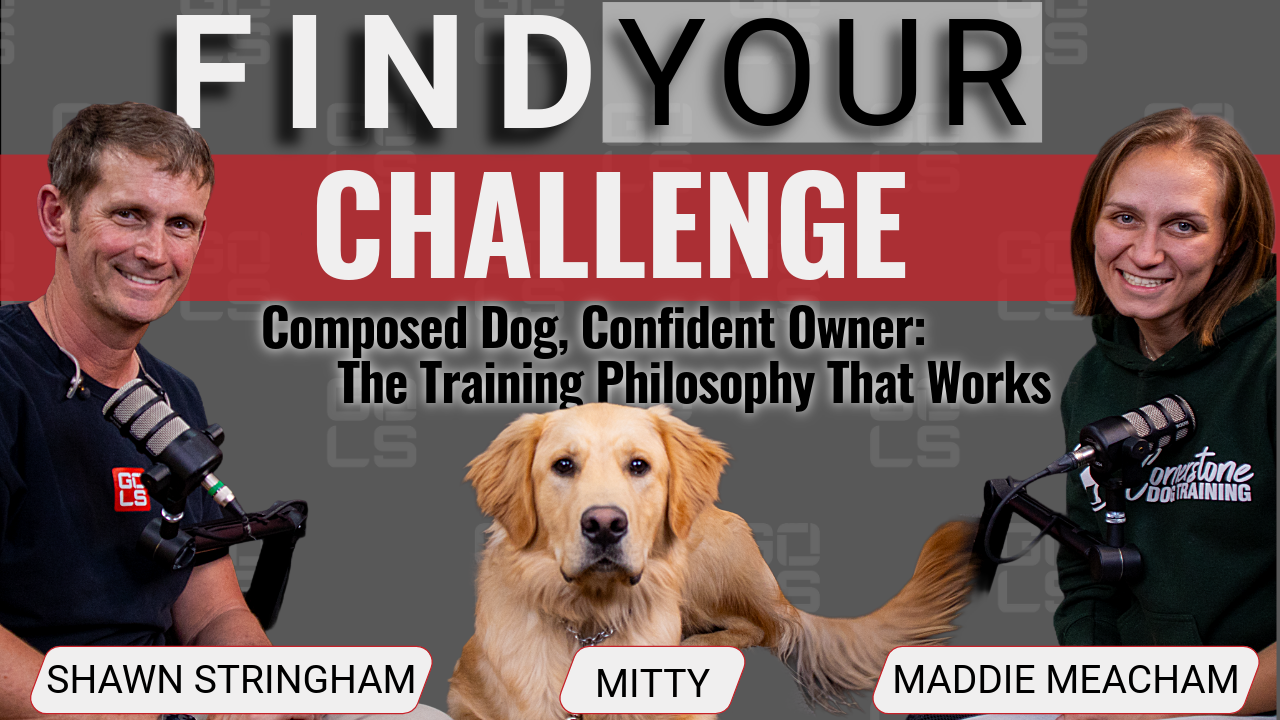
S1E5 – Composed Dog, Confident Owner: The Training Philosophy That Works
Maddie Meacham is a professional dog trainer, behavior specialist, and advocate for family-centered training that builds trust, composure, and lasting partnerships between dogs and their owners. She is the founder of Cornerstone Dog Training, where she emphasizes understanding canine psychology, structured socialization, and the critical role of owners in shaping behavior.
As a guest on the Find Your Challenge podcast, Maddie joins Shawn Stringham to explore the journey of training his golden retriever, Mitty. She highlights the difference between a “good” dog and a well-trained dog, focusing on composure, impulse control, and leadership as key factors in fostering harmony at home. Through personal stories and practical insights, Maddie illustrates how effective training transforms both dogs and their owners, creating calm, confident companions.
Beyond the podcast, Maddie champions advocacy, consistency, and investment in training as essential for every dog, regardless of age or temperament. She believes that integrating training into daily life, building clear boundaries, and fostering emotional understanding strengthens the bond between families and their pets, helping dogs thrive while supporting owners in achieving a balanced, joyful home environment.