

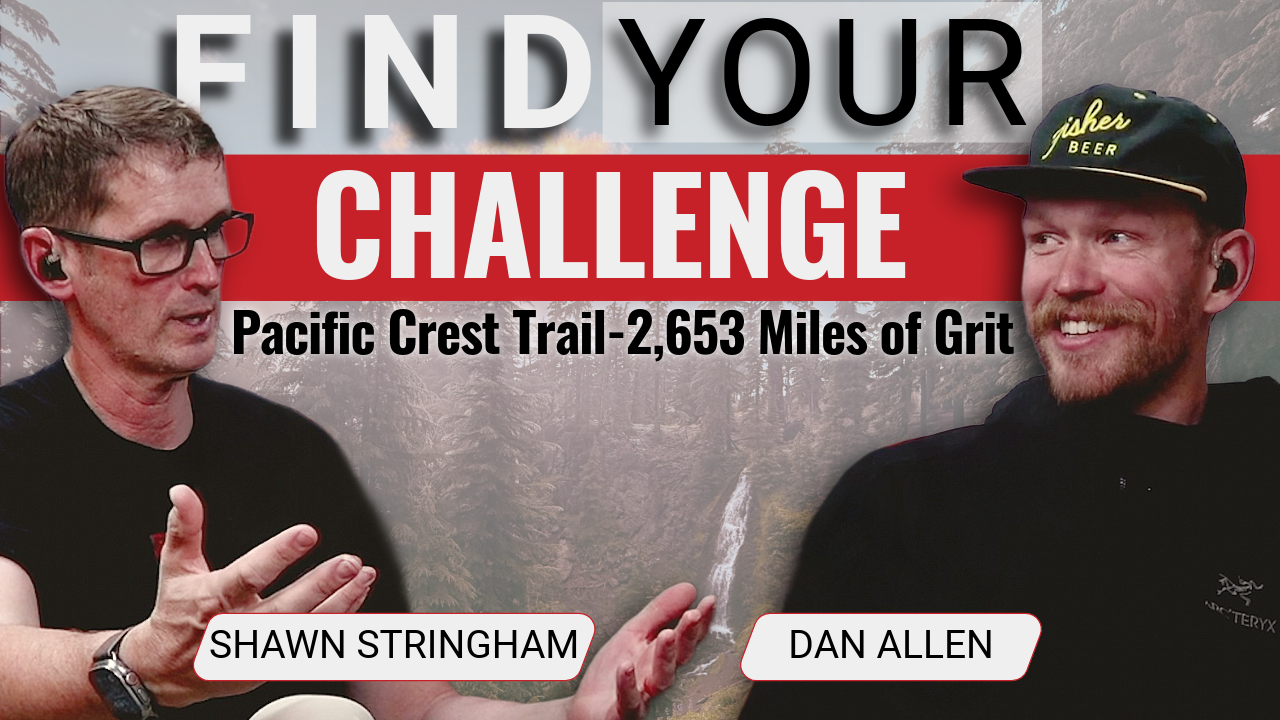
S1E2 – Pacific Crest Trail – 2,653 Miles of Grit
In this episode of the Find Your Challenge podcast, Shawn sits down with Dan Allen (@hikewazowski69) to explore pushing limits, embracing uncertainty, and answering the call to pursue something bigger through adventure.
Dan shares his life-changing journey hiking the Pacific Crest Trail, a 2,650-mile trek from Mexico to Canada that tested him physically and mentally. He opens up about the daily grind of thru-hiking, confronting doubt and exhaustion, and the resilience required to keep moving forward.
The conversation also highlights the role of family support, inner purpose, and mental toughness in overcoming long-term challenges. Dan reflects on moments of solitude that led to deep self-discovery and a redefined sense of success.
At its core, the episode underscores how intentional challenges—on the trail or in life—shape who we become, reminding us that growth happens when we step into discomfort and keep going.
Your challenge is waiting. Let's find it together. Subscribe and join the Find Your Challenge community.
Podcast Transcript
Shawn Stringham (00:05.678)
2,653 miles, five months, one step at a time. Most people dream about challenges like the Pacific Crest Trail. Dan Allen actually did it. But here's what you don't see on Instagram. The 2 a.m. moments when your body is screaming to quit, the lightning striking around you, starting forest fires, the mental math of 2,400 miles still ahead. Where's my next meal coming from? And the question every thru-hiker faces, why am I doing this?
Today, Dan's sharing the real story, not just the summit photos, the breakdowns, the breakthroughs, and what happens when you come home after conquering something that big. This is Find Your Challenge.
Shawn Stringham (00:51.246)
Hey, Danny, welcome to Find Your Challenge. Thank you so much for being here. I really appreciate you taking the time to come and tell us a little bit about your story of hiking through the Pacific Coast Trail. I'm thrilled that you're here. We have a history together where the last time you saw me, you dropped me on trail, on Lotaja.
Yes, thank you for having me.
Shawn Stringham (01:15.546)
We decided that it was 16 years ago, which was a long, time ago, because you 15 at the time, doing crazy things, which is part of this overall story. All I remember about that is that one of our teammates, and I will call him here, out, Rob Marsh, dropped us both. Do you remember that? He dropped us both, and the two of us worked from...
from probably Preston all the way to Alpine and beyond where we were working together and drafting in that terrible wind and you had the legs to keep going and the last thing I remember seeing is you riding away while I was hunched over vomiting into the weeds. you remember that?
No, but that's amazing you finished. Like the state you were in, I'm like, it's amazing.
It was, it was amazing. And it was actually one of the, cornerstone moments of my life. Actually that race I had, I had gone through the race a couple of times. I think it was the fourth or fifth time that we had done the entire thing. and I got so dehydrated and so like just the wind that that up, up, the canyon there into the finish. and this is probably not.
something people want to hear but to share, but I threw up all over myself 17 times. 17 times. counted and to this day, I still have a photo of me finishing that race on my wall to remind myself that I can do hard things. So you had a much better experience on that race. We're not here to talk about me by any means. Tell me from that time you...
Shawn Stringham (03:02.946)
completed Lodaj as a 15 year old. Here we've got a photo up there of me and you and our buddy Rob up there as we were getting ready to go to the race. We did Lodaj that you trained and then somehow 16 years later you've come up and now have done, you're an amazing through hiker having hiked from Mexico, the border of Mexico all the way to the Canadian border on the Pacific Coast Trail.
Fill in some of those details.
Uh, yeah. So I did the high school thing. I swam in high school. Um, I wasn't much of an athlete. didn't, I didn't really do much stuff in college. think in 2000, I reached out to you when you were coaching about some Ironman stuff. And then I, this was probably right around the time you're starting to get into podcast stuff, but COVID happened and the Ironman never happened. Right. Cause all the Ironmans were getting canceled.
That's true. And, anyways, after that, I kind of didn't do anything for awhile. And I just had this moment where I realized I needed another challenge and I had been following a couple through hikers on Instagram and
As soon as I started shopping for like, started chopping gear. Yeah. I was like, well, yeah, I saw, see the gear and the gear is what usually gets me excited about stuff. as soon as I had a spreadsheet of like, what would I take? Right. it was like game over because it was like, okay, I'm doing this.
Shawn Stringham (04:27.906)
your challenge.
Shawn Stringham (04:43.084)
What, what was the, what was the impetus though for wanting to do this? Like you had mentioned as we were in kind of as we were chatting before that, like it was part of a process for you to kind of come to this. mean, you obviously had done some endurance stuff that was important to you. How did you, what was the important thing to you to say? Like I can go hike for five months straight.
Yeah. My dad asked me at one point, he's like, why are you doing this? Like not out of criticism. He was just like genuinely curious. Right. and I was just like, I just kind of want to be the type of person who could. Right. And, at the time, I think part of the equation was like, had recently gone through like a really like kind of traumatic breakup or there was like,
like a terminal illness involved and it was really hard on me and the timing of it kind of lined up. And I don't know, I feel like people kind of view through hiking as one of those things. It's like one of those find yourself activities. I don't think it's, when I finally went out and did it, that wasn't why. Like I really just wanted to do it. And it was for me. But it did.
One of the byproducts of doing it was like, wow, it really helped me process a lot of stuff. like, you meet a lot of people out there who are going through all kinds of different things. People who are going through divorces, people who are getting clean, people who just want something cool and challenge them. And I would say I fell in that category. just wanted to do it.
So break it down. So maybe someone of our listeners, someone who's listening or watching along, like break down what it is. Like what is the challenge? What is the physical act of being this through hiker on the Pacific Coast Trail?
Dan Allen (06:41.184)
Yes. so this picture is a mile marker. the, the Pacific crest trail is a 2,650 mile trail. that takes you from Mexico to Canada and it's a continuous footpath. like a lot of through hikers, like different people will make different, kind of arbitrary rules for their hikes, but people who are purists.
They're going to try and hike every single mile of the trail. So, um, basically what it is, like logistically, you're planning. Like 25, like three or four day backpacking trips back to back to back to back. And so you're kind of like hopping off trail and going into town every three to five days. Your biggest carry, I think, I think our biggest carry was like
six or seven days.
You're out of town, you're planning, I'm gonna go be on the trail for six or seven days, or typically maybe more three to four to five days. You're putting that trip in, so you're not out in the wilderness for five months straight carrying all of your gear at the same time.
Yeah. And there's different ways to hike it. Like if you wanted to save more money and have more town days, cause towns just expensive, you're to be spending money on accommodations and food, which adds up pretty quickly. but there's also ways to hike like super, super affordably, which a lot of people do. And through hikers also tend to divvy up.
Dan Allen (08:21.996)
Like we'll split things and like we'll split a hotel room. And it becomes like a really tight knit community. A lot of these people become like your family out there.
Cool. So, you, it's permitted. You can't just go show up and do that. I learned that from your Instagram account, right? Like you have to have a permit. You started this, I believe, I want to say like May 10th is when your permit starts, right? Is that correct? Yeah. So May 10th of 2025. So it's been this calendar year and took you how many days?
it took me a hundred and... twenty-nine days, I think?
And so you wrapped up, I hit the Canadian border in on 15th, September 15th. So as it, so we were about two months, just over two months from that, from when you have finished that, as you look back now, is it becoming, is it becoming more exciting or I get, because the wrong question is like, you still like thrilled with your accomplishment? Like, is it something that you think about every day still?
September.
Dan Allen (09:29.87)
I don't think about it every day. I, yeah, I, um, no, like, yeah. I think for a lot of people, um, like I just didn't want to come home and have it be like my whole personality, like be the annoying guy that like when I was about your high, sure you know what I did this. So, um, I was like, conscious, conscious about like not.
Yeah
Dan Allen (09:56.664)
bringing it up all the time. But my family was like really sweet. They like threw me a party when I got home and it just kind of gave me a chance to like, people wanted to hear. Right. For sure. First of all, like, so it was just like all close family and friends that came over and my, my dad like put a bunch of pictures of my trip up on the wall. And I was like, able to tell everyone about it. Yeah. And that kind of helped me get it out of my system. I was just like, like people cared and like they wanted to hear about it.
How much time before May 10th did you spend planning the adventure?
I think in earnest, I was like planning and saving for like three to four months, is like short. Right. It's like a lot of people spend multiple years getting ready for through hikes or like a whole year. so it was kind of like spur of the moment for a through hike, but, in terms of like me deciding I wanted to do it and then just like making sure that I would be ready. Right.
When you were doing that preparation, like go back into that timeframe, what were some of the things that you were most frightened about? Like what were the things that were the anxiety or the criticisms in your mind of like, is, what am I doing here?
the two things for me were finances and injury. Okay. So like overuse injury, I knew nothing was going to take me off the trail unless I got like, couldn't walk anymore. Right. So, like I knew my, willpower is there. knew I'd be able to go get through the whole thing if I just stayed healthy. Right. and so, but I also just didn't know like how much.
Dan Allen (11:40.302)
like long distance hiking, I'd be able to get in with my job. like I work pretty physical job. I'm a construction worker and, um, but it also lit a fire under me to like make, I think I made more money first three months of that year than I did like the whole year before. And I was motivated.
You're motivated. And so like, how do you train for it? I mean, we've, we've mentioned Loaded Joe, we've mentioned Ironman, all things where you have this very structured training plan. You know, you're doing X amount of hours every week. Like how do you train to go hike a hundred and X a hundred, a hundred plus days a year? Yeah.
it, sounds insane, but you like can't. Right. Like, you do, you try to put in as much hiking as you can, I would say. Yeah. like strength training and hiking, would say are probably going to be beneficial in terms of getting you ready for the trail. like hiking 10, cause I started out, I didn't start with like 25 mile days, which is what I kind of average the whole deal. 40 miles was like the biggest day of that.
we had on trail, which was in Oregon. And that was just like, yeah, there's my watch.
very nice.
Dan Allen (13:02.582)
You start though, you start by hiking like 10 or 12 miles a day. Right. Very beginning. you just, yeah, you want to go slow. I would say before the trail started, I was doing like, I would just go out on the weekends. I'd hike all the classic Wasatch mountains. Like, it's like, I would go do temp or I'd go do like lone peak and just like get some hard hiking under. Yeah. Right. So that's pretty much what he did.
you train yourself into it.
Shawn Stringham (13:27.938)
Some elevation too, as likely as that.
the elevation pretty comparable? mean, probably when you're down by Mexico, it's a little bit lower elevation as opposed to when you get up into the Cierras. How does that compare to those of us who are Salt Lake centric, right? We're 4,700 elevation up to, you know, if you're doing Lone Peak, you're going to be hitting 11, 10,000, 11,000 feet, right?
Sierra.
Yeah
Dan Allen (14:00.622)
would say a lot of the mountainous parts of the trail are fairly comparable elevation-wise. is like one of the, it's not technically on the trail, but it's like so close that a bunch of hikers do it, we'll just do it.
Yeah, which is about over 14. That's a 14er, right?
Yeah, yeah. It's the highest mountain in the lower 48. Nice. And yeah, this is a picture of us. actually stayed the night up there. Me and my buddy Gavin and Duke, we all just, it was so cold up there. Right. We probably got like four hours of sleep that night. But yeah, it was kind of a spur of the moment. I don't recommend doing that. I don't think it's even allowed, but like, we woke up like 25 miles from
the summit and in the morning and we were just like, let's just go for Let's just go for it. Why not? It was kind of dumb, but we did it and it was fun.
So let's talk, let's a little bit more about setup. You, you worked for a couple of months, you're taking a period of time to get ready. How did you organize your support system? Like talk through like what it takes to get the support you need, where it needs to do while you're transitioning, transitioning from Mexico to Canada, right? Like that there's, there's some logistics there that have to be handled.
Dan Allen (15:05.656)
for.
Dan Allen (15:24.878)
100 %
I couldn't have done this trip by myself. There's just no way. I, I wanted to like, but, and, my, my mom and my family were just insanely supportive throughout this whole endeavor. Like, um, my mom did all my nutrition. She sent a lot of people will send themselves boxes. There she is. She's great. Um, couldn't have done it without her. She was amazing support and.
on the screen.
Dan Allen (15:57.838)
it just made the hike so much easier. Okay. Like that. Yeah. She did this crazy assembly assembly line on our, on our kitchen table. And like, was like a part-time job for her, like sending me food. Right. And when I saw it all on the table, I was like, my gosh. Cause well, originally like.
Was this all packed pre-hike? No, no.
no, this was during, so originally I was like, I'm just gonna do my resupplies on the fly. Right. And she's like, when can I send you a box? When can I send you a box? And I was like, I should probably like take advantage of the support.
They're awesome. Yeah
So I like, told her where to send the first box and she just ended up keep sending them to me throughout the whole journey. when I said,
Shawn Stringham (16:44.364)
Each of these, like, tell me the story of this photo here. Like, we have how many boxes there? 10? Let's call it 10 boxes up on the screen there. All going to the same address? All different addresses?
So those are all like three or four days of food, spaced probably around like 150 miles apart. Okay. And just different towns, lodges, different spots where you can send postage right along the trail.
And once you get into the community, probably know what those addresses and things are. Like, is there some place to know that, right? Like, as you're putting stuff together that way?
Yeah, if you want to do the PCT, there are so many resources that like, there's just been, there's so many people who have done it. There's like a few thousand people who attempt it every year. Like probably a few hundred people who've ended up finishing it. But the...
Dan Allen (17:45.058)
Sorry, let's try, sorry, what was this?
We were talking about the food and having those boxes space three or four days. Right. so here's box one and it's going to this location. Here's box two. It's going to this location. How are you communicating that? Like how are you and your mom happening? In my mind, like you're out on a sat phone or you're coming into town and then you have, or you have cell connection. Like just, I'm just curious about the logistics of the whole thing. Yeah.
So a lot of people use inReach. I just use my iPhone. I got a new iPhone. The newer iPhones have the satellite texting capability. that's, I would just like hold up my phone in my tent and she would hopefully get the message of where the next one needed to go. When it was like, so we got it down to like a science and I just kind of let her plan.
Right. Like once she kind of knew how many miles I was averaging, she was like, he's going to be in this town at this time. like, yes, like it was incredible. Like she went so far above and beyond and like, even like other hikers would say to me like, yeah, like my mom is like, mom. yeah. Well, then they were like, they were getting stuff from their parents, but just like the attention to detail in these packages and like,
So massive shout out mom.
Shawn Stringham (18:57.966)
your mom be my
Dan Allen (19:07.776)
She would like put like vitamins on every package that would
So break down, like open one of those packages and tell us what's in it. Like when you saw, like what were the things that you like, like what are you using to fuel yourself for this endeavor?
Yeah. So there's usually a couple of mountain house meals. and then there's like three, I ate oats every morning for breakfast. it was like super oats. Like my mom made like these amazing, had all these crazy ingredients in it that were just like fueling me. and then lunch was just like, it wasn't really lunch. was like, it was just like a bunch of like carbs, like a bunch of snack, snacky carbs.
and then at night it was usually like, refried beans with like some of the, some of the dinners she would make and some of them were just like,
Yeah, cool. All right, so we just finished wrapping up talking a little bit about the boxes and the delivery and the food and a big shout out to Naomi Allen for tracking and being the ultimate mother to you and to the other trail hikers, the thru-hikers that were with you. The power of an incredible mom is a fantastic thing. Let's talk about your gear a little bit. We have some featured guests here on the table. We've got a tent, we've got, I'm assuming, sleeping bag.
Shawn Stringham (20:33.614)
Some other stuff here. for those, since you can't be here with us guys, this smells like adventure. Like we're getting the full experience. We're getting the fourth dimension here, full dimensional with the smell of like, which of these things would you kill for at this point? Or would you give them all away? like maybe while you were on the trail.
I apologize for that.
Dan Allen (20:59.022)
You need to be burned, right? We need to go in the landfill. But I loved my tent. My tent got me through my trip. And that's like another note on support because my siblings all on my birthday last year, they all pitched in. I have like seven siblings. And so they all pitched in and bought me my fancy Ultralight tent.
Which, the bag is threadbare, like it's poking through. How many more nights could it, would you take it out anywhere at this point? Still at this point? Or is it like, is it like-
Good shape actually that it's just the bag that's a little rough from getting shoved in.
Is it something that you feel like that you're going to take with you the rest of your life? Like, because people have asked me like, you know, you shouldn't ride that bike anymore. It's like, but I'm never going to get rid of it because you just have suffered so hard on it, right? Like you're really probably, I'm never going to ride it again, but like I'm never going to, it's just going to hang on my wall and remind me of how, of all of the crazy adventures type thing. Like, but you still, it still has life.
Yeah, no, I'll probably take it on a few more solo trips. I would never subject anybody else. I mean, it's a one man tent, so gravity ounce can use it with me. it's just like, I'll probably end up getting all new backpacking stuff in the next year or so.
Shawn Stringham (22:20.374)
And so back to the smell, made an interesting comment about this is like, it's like I said, let's just call it, it smells like adventure. But while you were out on the trail, you're saying that the thru-hikers, you don't smell it. Like what's the shower, you're not showering for a hundred plus days? how are you, how's the hygiene situation that's working out?
The hygiene is going and swimming in lakes. Okay. When you can. Yeah. And then when you get into town, you try and shower like all the grime and dirt off your body. Right. And it, can get pretty gnarly. Yeah. But yeah, you're nose blind to your own odor. You can smell like normal people really well. like anytime we were like close to a trailhead and there were day hikers around, we could, we'd be like, well, like I can smell your shampoo or like, like your
perfume or whatever.
And was that like, was that as you got out there, like did you not, don't want it like, does that put them at risk? Like you feel like you, like you got the grizzly bear sense going on here like that. Like I guess, you know, talk just more about that, about smell or the lack of smell.
well, we would like, so people being kind to us was really like common. Like we would have to hitch into town and so we'd get into strangers cars with all of our stuff and our smell. every time like, every time we'd get into a car for a hitch, I'd be like, be honest. Like how bad is it? And people were usually like, it's like a seven out of it. Like it's pretty bad.
Shawn Stringham (23:47.148)
Part of you at guys.
Shawn Stringham (23:59.436)
Yeah. Okay. Let's go into the first week you started, you had mentioned, and like, this is a five month experience. So we'll start with the first week, maybe end with the last week. On that first week, you'd already mentioned that, you know, you're only doing only quote unquote 10 to 12 miles a day. What hurt that you didn't expect?
Yes. tendonitis in the desert. I was expecting my knees to blow up as I had some pre-existing like IT stuff going on, but, no, yeah, it was tendons. So it was like right around Palm Springs. I was dealing with some overuse injury and I did exactly the right thing. I just like got off trail. I took three days off and I was fortunate enough to have like a family friend. had like a little time share.
in Palm Springs that I was able to stay in. Yeah. And, yeah, I just stayed off the feet, iced the ankles, ate a bunch of food, took a lot of ibuprofen and I was back on trail.
What about that in that first week was the easiest thing? Like, you were nervous or maybe anxious about something that like just ended up not being an issue.
I think all of my cares and worries were like, gone. I think that part of the appeal of doing these trails is just like, you have no responsibilities. I mean, I guess if you have like a family and I, I'm, I was single at the time, so it's just like, yeah, like I, I had nothing to worry about or it was fantastic.
Shawn Stringham (25:18.262)
Okay.
Shawn Stringham (25:39.416)
So as you're moving along the trail from week one into two, like first month into second month, what, like talk about just the mental, like, is it exciting every day? Like you're waking up and thinking, I can't wait to go walk 25 miles. Like what, what is the mental game that goes into it? Because right at some point, the physical point just takes care of itself. Like you've walked yourself, you've hiked yourself into shape. You know what's happening. You've got your routine.
Sounds like you've got some friends around you, but there's gotta be just that mental of like, long did it take you to hike 25 miles in a day?
usually we would start hiking around like six in the morning, just to like beat the heat or, or whatever. And then we'd usually get into camp around like five or six, depending on the elevation. Every day was a little different and you just had to listen to your body. like, we all use this app all the through PCT through hikers use this app called far out. And it just like shows you.
where all the water is on trail so you can plan your day around like water sources. can plan camp around water so you don't have to dry camp. And so yeah, you're, you're usually hiking around like.
You're pairing a filter probably with your water filter with you.
Dan Allen (27:00.45)
Yeah, I have this squeeze filter. Nice. Yeah, so you just hook this up to like a smart water bottle. Okay. That's the most common thru-hiker water bottle. Okay. And it just threads on there.
And did you, for lack of a like, it's 2 a.m. in the morning and you're laying in your ultralight again for day 140, right? Like, what are you, are you sleeping like a baby? Like, the best sleep of your entire life? Or are there, are you, is there a crisis there in your mind? like, you, do you have mind games that's going on with you? Just like, take us through the mental aspect of the whole thing, yeah.
like the mental.
Yeah. So I would say the mental and the physical challenge of it like kind of trades places. So like in the beginning you have the novelty of like, my gosh, I'm doing the PCT. This is great. Right. Here I am physically really hard. I like my body's like not ready to hike this much every day. Right. And you're just sore and your body hurts for like the first week and you kind of just get used to it. but
But your mind's there. You're just like all in it. You're making a bunch of new friends. Like all these people are starting trail the same day as you. And you're like kind of building a community around yourself. but then like towards the end of the trail, you're like, okay, like I can walk all day long. I can walk. It's easy. It's like, and some people would disagree with that. Like it felt easy to me.
Shawn Stringham (28:23.086)
That's not the hard part anymore.
Shawn Stringham (28:30.656)
One of your comments that I read on your Instagram post was like, if you want to come over and see my awesome athletic body. It's like, okay, now we're talking here. Like what's like a, did you see physical changes?
100 % yeah, there was one time we were hanging out at a river and there was like a nice pool for people to swim in and one of my friends was going around with the camera like taking a video of everyone. I was like just kind of over her shoulder like while she was like editing this video she's gonna post and we're like I saw like I saw the video of myself and it was like my gosh like body dysmorphia like I like I had six pack. What like I didn't believe it was me.
Cause I wasn't like, you don't see yourself in a mirror. Like you're not looking at yourself all the time. Cause you're like, you're in a hotel like every few days.
Right, yeah.
Shawn Stringham (29:22.646)
How do you, like how are you managing technology? How are you, like you said you have the phone, right? So you're gonna go out, I'm assuming the battery is such that you're keeping it on airplane mode until you wanna do, like how are you, the communication tools, right? Like, cause you're gonna need that from a safety standpoint in case something does go horribly wrong, right? Like I'm just curious, like what, do you have a GPS with you or you, how's that working?
Garmin, the Garmin watch, the phone. And then the way you keep everything charged is everyone has these little battery banks. you just charge up, they're like 10,000 milliamp battery banks. They're like made of carbon fiber. And you charge those up every time you're in town and that'll keep all your stuff charged. Reach Hall.
Nice. So it's like, it's amazing. Like there's specific technology for each of these questions that we're, that you're dealing with. Yes. Um, what about, uh, the community? Let's talk a little bit more about your community. You've mentioned you found, like, it sounds like a class of people that starting on May 10th and you're all heading out together or like, are you finding people along the way? Like talk, just talk about that, the wilderness community that's out there. Here's a good look of some.
This is a picture of some of my trail family. They got out to the hog wild plus family. was a, that's our, that's our group chat. Okay. but we were called hog wild because we'd get into camp and we play this game called pigs every night. Right. but yeah, so the community, the community aspect of the PCT is fantastic and unique and.
You meet just people from all over the world. There's people from Japan and Australia and all over Europe and you're meeting all these international hikers. Right. And it's...
Dan Allen (31:19.946)
It really is one of a kind and like the whole trail culture thing is like everyone's got their silly trail names and like at the beginning I wasn't as into that. Right. But like by the end you're just like, it's your life. Right. Yeah.
So you had mentioned upfront like that thousands and thousands of people start this and only hundreds finish. that, yeah. Say more about that. Like what are the percentages? Like how hard is it?
I can never like find an accurate, I guess it's like self-reported. Yeah. on the, unlike the little, they do like a questionnaire at the end of every year. but yeah, I actually don't know the numbers off the top of my head for like how many people officially finish every year. Okay. but yeah, I think they issue like a.
few thousand permits every year and like, there's like 30 or 40 people starting trail each day, March through May. Right. And then, so you start trail and if you're starting in May, you're presumably like a little, like a faster hiker and people who want, who trying to start earlier, they're, they're trying to give themselves more time. and so like,
I went into it thinking that I would do it like sub a hundred, which I didn't do. I thought I was going to just be this beauty hacker. Cause I had this other friend who he did it in like 84 days. Like he was just like, he didn't, he didn't make any friends. Like, no, it was way more about like the athleticism for him, think. like still like incredible accomplishment. but you would have to be, he's like a ultra marathoner type of guy.
Shawn Stringham (32:57.41)
my gosh, what?
Shawn Stringham (33:01.986)
He sounds less fun. Honestly.
Dan Allen (33:17.146)
And you would have to be like doing like 30, 30 mile days from the get go in order to make those kinds of, yeah, kind of average.
So there's a moment in these massive challenges, That you're, you know, this is obviously a key example, loadage is another example, like the people are going through on these physical challenges where something just kind of shifts and you go from surviving something to maybe thriving, right? In those situations, do you, can you think, is there a single apex point on your journey where it's like,
this is incredible. I'm just gonna continue to go out and kill this. Would you have that specific moment?
Yes, I think the moments that you got to share with people in some of the most beautiful locations on the planet, between the Sierras and the Northern Cascades, the most beautiful places I've ever been in my life. Just unforgettable scenery. I would say those moments when we got to camp and live in those places was just like,
And that was when I was like, yes, this is what it's all about. This is why I did it. And that was why I chose the PCT as opposed to some of the other long trails that I could have done. people will debate and argue about which one is their favorite, people who have done all three.
Shawn Stringham (34:48.418)
being PCT, Abolatia,
and the Continental Divide. And I met a few people who had done all three. But I'd say the general consensus is that the PCTs is the prettiest.
And you want to go south to north because you end in Oregon, Washington, like Sierra's, as opposed to tromping through the desert is my guess.
Yeah, that was my thought. but I am following a couple hikers right now that are like, they're, they're wrapping up their hikes right about now and they were southbound and I did not envy some of the, the, weather that they had to deal with in the Sierras. But yeah, no, that's the idea is that you're, you know, it's a high point. Right. The Northern Cascades are unreal.
Fantastic. So you mentioned as you got into this that it is probably impossible to go hike 2,600 plus miles and not have moments of self-discovery and not like process a lot of different things. But would you say what surprised you the most about yourself on the trail?
Dan Allen (36:00.598)
You, you find things out about yourself that you just didn't realize. Like I, one thing that I realized is like, just, I, there was moments when I would like give support to other people who are just having a bad day or like were physically injured or like maybe some like minor medical attention. And I would like, I would just like step in and give them what they needed. Like I real, I was like,
thinking about it and I was like, maybe I should do like a woofer or like a first responder type course. Cause like, I really enjoy like helping people in this way. And, um, I feel like I'm good at like talking people through their emotions and like helping them manage like a stressful, like physical situation where they're like, they still have to hike like 20 miles to make it out. Um, and.
So that was something I discovered about myself that I just didn't know. And then there's the obvious, you're alone with your own thoughts every day on trail. I mean, you can listen to podcasts and music. If you wanted to, you could be plugged into an audio book or whatever.
Yeah, that that's a challenge at the outset. It's like a hard to be, I think, today's world.
Yeah, mean, you're taking a world of distraction and then putting it onto a lone trail for 2,600 miles, right? Like, so trying to process that and have your, like, did your brain go through like, I'm missing my Instagram posts or I'm missing like to see what's happening with these text messages. Like, did it, did it take a time to detox?
Dan Allen (37:49.87)
from that? It's funny because I don't think anybody is more addicted to their phone than like a PCT hiker. Once you get into town. Right. But when you're out there, you don't care. Yeah. It's like, it's just nice to be out there. Okay. And you're like, you're in it. Yeah. And you'll take pictures, you'll whip out your phone and be like, oh, this would make a great photo. But other than that, you're like, unplugged.
Right.
Shawn Stringham (38:14.059)
Was it all positive? Was there a moment where like, I'm out, I don't want to do this anymore? Did you ever think about quitting?
I think I had like three bad days. Okay. Yeah.
define like what would tell us about the worst of them.
would say probably the worst day was, we were headed through Northern California and North North NorCal is like notoriously, difficult in terms of like blowdowns, elevation and the
Sounds like a putent
Dan Allen (38:50.414)
trees knocked down onto the trail that you have to climb over. And a lot of it is because of the wildfires. There's a lot of like burn zones that you have to walk through. like there's also just, it's not great to look at sometimes where it's just like everything's burned down. I think that stuff also kind of has its own charm, but like a lot of people couldn't be more excited to get out of Northern California, right? And on the thru-hike.
Right.
But there was this day we were hiking up a section and there was a wildfire that's that popped up about 30 miles north of where we were. It's not the same one, there there's that's another part of the PCT is like, you have to account for there's probably going to be parts of the trail that you can't get to access because of, you know, active relic fires.
I was very fortunate. think I only, I skipped less than 50 miles of trail, because of, either like stuff that was just totally closed off or stuff that was active. Right. But, so sorry, back to the, the hard day. it was hailing, it was busy hailing and then started raining pretty heavily. And my friends, actually had to rescue a German guy off of the mountain.
because of some flash flooding that was happening on the mountain, his tent, his shoes, his, everything just got washed away. And so he was just shouting and didn't know what to do. they like shout. Yeah.
Shawn Stringham (40:29.228)
German? Shouting in English? He was making he was making human distress sounds.
Exactly. And so they, they just walked them off the mountain. We were further ahead before the flash flooding started. So we were kind of like up on the mountain. We decided that we were going to try and finish the section of the hike. they were like, we're not doing this. And then, we'll just meet you at the next trailhead. Right. Or the next town. And that night there was like several lightning strikes around us. my tent got.
flooded out the first spot that I attempted to set up at. was talking to my friends for probably 15 minutes and they were just like, what do we do? There's lightning strikes all around us. Like, we going have to get evacuated? we were seeing stuff start like around. And we're just getting pelted with, with hail and stuff too.
started.
Dan Allen (41:29.74)
So morale was really low. And I'm talking to my friends for like 15 minutes and I look behind me and it's just a river going through my tent. And so I like wrap up my wet tent that weighs probably like 15 pounds at this point, strap it to the back of my bag and we all like just keep hiking and we try and find the next campsite that's like not exposed. Cause we don't want to get hit by lightning.
It's always a goal, right? Don't get hit by lighting, right?
Okay. And so that was a pretty low day, but the next morning I just dried out all my stuff. It was sunny and there was firefighters putting out all the little stuff.
So you went out pretty prepared. You said you pushed the preparation, but like obviously an athlete, everything, this makes sense. You have great support systems, food coming in, all of those. Are there people that are out there that are just in above their head? Like in over their head or by the time you get to the end, one way or the other, is it all, I guess, are people doing this under prepare in general? Like what would you say? Yes.
There are people who are in over their head. are people, well, and sometimes people surprise you. Cause like there's a bunch of people starting the trail who in your head, you're like, you're probably not going to make it. Right. Like they just don't have any, like I grew up backpacking, like doing boy scouts and stuff. So like I, I'd been on some trips and like, but I was not like an avid, like out every weekend backpacking type of person. But,
Shawn Stringham (42:40.034)
Right.
Dan Allen (43:06.646)
I had some experience I knew. when I saw some of other people who were starting, I was like, OK, I'm going to be OK.
I'm gonna make it.
Like, well, and for some people just aren't used to the desert. All right. So I had a leg up there too, right. Like being in from Utah. but sometimes people will have no experience and they'll have all the wrong gear and they'll still make it to the.
All right. Let's go through some photos. Like maybe a bad, a bad way to say the lightning round of photos. Yeah, sure. We're going to have Chloe pull up some photos for us. there's some, there's some epic, there's some epic photography here. and so like take us through what we're seeing, what you love about it, like where you are, all that kind of stuff. All right, here we go. Waterfalls.
Yes, so this is Tunnel Falls in Oregon. This is a big landmark for folks on the PCT because you just know you're getting close to the end and it's obviously just such a cool spot.
Shawn Stringham (44:14.05)
Right. And so how, I mean, we don't see the bottom nor the top of that falls for those of you who are maybe just listening instead of watching. what's the, how tall was that?
I was probably a few hundred feet. looking, what I'm looking down over in that photo. It's like, you don't want to fall off of that. That's how I did
Shawn Stringham (44:33.934)
All right. Okay, up next here on the lightning round of photos.
this is a bird that I found that I don't know what kind of bird is. I texted my cousin because he's really into birds.
Yeah, everyone needs to that, cousin, for sure.
He knew exactly what was, but this was in...
northern cascade
Shawn Stringham (44:59.802)
Was there, what kind of, like, did you have to deal with animal life? Like, other than birds? Like, birds are less threatening than maybe some of the others, right? Like, what are the... Okay, tell me about the bear encounter.
Yeah, I a bear encounter.
Yeah, there are no grizzly bears on the PCT, you're probably not going to get eaten. Black bears are pretty skittish, so you just try and be safe with your food.
they'll take the food but not kill you but like
Like they will. Yeah. mean, it's just, it's good to just like, not even put them in a position where they're going to like, be attracted to your food. Okay. So like having a bear can where that's required and you know, food hangs. I, I try like, I tried to be disciplined about that where it was required. Right. I was pretty lax where it wasn't required. but yeah, I, was just kind of hiking. I had headphones in, I was hiking along the trail one day and I like,
Dan Allen (45:59.864)
blasting music in my headphones, but, I just see a blur, like, like a few feet ahead of me on trail. I'm like, what's this.
What is this? This is large mammal.
And it turns around and looks at me and I just started yelling at it and yeah ran away
Alright, Naomi don't listen too close. Alright, next photo here we've got.
This is the bridge of the gods. It's the border between Oregon and Washington. And it's like, it's huge for through hikers. It's like, it, feels like you're almost done. Cause you know, you know, Washington's only going to take you like two or three weeks to hike. Okay. And you don't have fast.
Shawn Stringham (46:44.174)
for like time context, like two or three weeks of like hiking 25 miles a day and I'm feeling good. Like you're at the end, huh? Final lap.
I did Oregon in 15 days. Wow. Yeah. So that was like, I think you're averaging like 30 something miles to do that. Okay. All right.
What's our next photo here? Let's see, we've got, that's a great one. Let's take a look at this.
Yes, I am, this is in Oregon. I am unclear on the exact name of this wilderness area. I'm so bad with all the names.
But it's beautiful in Oregon. So, having lived in Oregon and in the Cascades, this is amazing how beautiful it is. and like, I'm seeing it from the car, right? Or from a ski resort type thing. Like, as you get deep into the wilderness, how do you get, do you get, does it ever stop being amazing from a nature standpoint? Like, what you're seeing?
Dan Allen (47:43.156)
It's funny because like, no, no, like I would say there's enough really, really cool stuff on the PCT that you're like, it's impossible. like some of the stuff you'll be like, you'll see it and you'll be like, not as cool as the high Sierra, not as cool as like Crater Lake.
This is
Shawn Stringham (47:59.278)
Yeah
Shawn Stringham (48:04.501)
Let's bring up Crater Lake.
So this is Crater Lake, one of the coolest spots. Wizard Island in the middle there. I was like, that's the coolest name for an island that I've ever heard.
Here's my own personal crazy Crater Lake story. As I mentioned, Melissa and I lived in Oregon. We went to Crater Lake. Melissa was eight months pregnant and we went for a six mile snowshoe. That will tell you some of the greediness of Melissa. Started a little pre-labor while we were five miles out. Had to walk back and get home as quickly as we possibly could.
You're like, you were probably down.
We were up on the rim because there snow. It was like, there was 20 feet of snow. So we were just like, snowshoeing or we were cross-country skiing, I think around, but it was like, it was super cool. it was one of those of like, first kid probably shouldn't have done that. like, it was still fun. All right, let's do this next one. What do we have next?
Dan Allen (49:03.672)
This is a camping spot that I did in Goat Rocks. Goat Rocks is unreal. Goat is Washington. People always say the photos don't do it justice. Goat Rocks is one of those places where you can attempt to take pictures of things and you can't.
no rocks weren't st-
Shawn Stringham (49:24.174)
Right, capture it, right. Amazing, okay. Let's do, yeah, this is a good one, let's do one more.
this is Rainier. I think that's a few just like just after Goat Rocks getting into Goddard Rainier National Park.
Fantastic. so didn't summit Rainier, but did summit Whitney. And there's a photo, let's find it like while we're chatting about that, Chloe, if you can find that photo of Mount Whitney, that would be incredible. Tallest mountain in the continental US. And you had mentioned like, hey, it's only 25 miles away. Let's go get it. I mean, do you have, you're confident, physically confident, have the food, you have the friends, you have the support system.
Not a big deal. Like to go just take that summit and bag it.
I think, I think it was probably a bigger deal than we felt it was because I, I think we, couple of the guys I was hiking with, they're not from like super mountainous States. of the guys from Florida and towards the top, was like starting to feel some headaches and you know about elevation, like that can get serious really quickly. and so we were just paying attention to him really quick, like
Shawn Stringham (50:18.679)
Right.
Shawn Stringham (50:30.968)
not very super amount.
Dan Allen (50:42.786)
really closely and just making sure that you know he wasn't going to come down with like some cerebral edema or something like that.
Alright, what
Why do you think humans need challenges like this? Like what's, what, and what's, what's great about it, whether it men or women, like that's like the essence of this podcast, right? Is having people find their challenge, right? Like what did you learn? Like what, what's the most important thing that you learned?
Yeah, that's a great question because the PCT is one of those things that is just so arbitrary. Right. the whole like just hiking from point A to point B just for the heck of it.
I think people need this kind of thing to just experience from the context of the PCT, like to experience life and to process life in the society we currently live in. Like, I think something like a through hike is maybe a great rite of passage or a great like opportunity to just like detox from
Dan Allen (51:58.602)
everything crazy that's happening.
Do you want to do more? Do you want to do like continental? Yeah, continental divide or do you want to do? I don't think I will.
Yeah. I thought I would. thought that after I finished, I was going to want to be a triple crowner. Right. yeah, no, I think I proved to myself that I can like, that I could. Yeah. If I wanted to. Yeah. there's just a bunch of other challenges. Right. Are drawing me more.
Do you think that as we, as you've aged here, like we mentioned, like our connection started with 15 year old Danny doing something that most 15 year olds could never or would never do and go ride 206 miles in one day. Like would 15 year old Danny be like excited and proud of current Danny? Yeah. Right? Like, and, and are those things connected? Like, do you feel like that was part of your, like what you want to do in your life?
Yes. Yeah. The ride that we did when I was 15 was like so important from like my self-esteem. Right. Because up until that point, sports were not like a, they didn't engender confidence in my life. Right. Yeah. I kind of got bullied like doing sports up to that point. And I just wasn't really good at any like team sports, but I found like cycling gave me something to hang my hat on and I
Dan Allen (53:26.794)
returned to like when I was looking for my next thing, like what was my next challenge? I went back. I was like, yeah, I felt so fulfilled and happy and just like I could do anything that I set my mind to after I went out and did Loda jaw. And it was part of what guided me to the trail. Cause it was just felt like such a cool intersection between like witnessing beauty.
and like doing something really physically hard. Right. And I was like...
How do you think it will shape your future?
I think it's really, it's put me on an upward trajectory and I was, I was worried about getting depressed and sad after I got home and it was hard for like a couple of weeks to like find my feet and get back to work.
I just, I just think it's, it's just given me the assurance that I can do, I can do hard stuff. like, it's, it's this, this is where it sounds corny, but like,
Dan Allen (54:43.374)
yeah, like dream it and do it.
Yeah, totally. Like, dream big, right? I mean, it's...
It's kind of like a manifest thing for me. Sure.
Trust me, I'm a huge manifester. Podcast being one of them, right? Like this is something I've thought about for years that I've wanted to do, so.
Yes. Yes. And, and I think this whole experience taught me that like, you
Dan Allen (55:11.586)
You picture exactly what you want and
like it doesn't happen the way you think but I don't know it was I don't really know what I'm saying but I
Dan Allen (55:29.772)
I think.
Yeah. Sorry. I'm kind of losing my train of thought here. I think it's, it's just a positive upward spiral from here. And I, I don't know what my next big like physical challenges I've thought about doing like rim to rim to rim. Like the Grand Canyon thing. then, I've thought about doing the Whirl, locally. Yeah. But.
So talk about reentry. You said you had a little bit of, you know, you were worried about that, but you've started a business. Yeah. Talk about your business. Talk about what you're doing. your reentry from middle of September to here now, several weeks later, like you've got cool things happening and you sent me some photos of some of the incredible saunas that you sent. Like, so yeah, sell your business here. Yeah, I'll do a little plug. For sure do a little plug.
quick. Yeah. Um, before I left, I, so yeah, I, started a general contracting business about a year and a half ago, Eastwood contracting. And before that I worked for a custom home builder for about three years. Um, his name's Parker Davis. Who's the best boss I ever had. Yeah. Parker's great. And I, he, taught me all the building skills that I have and was a great, great mentor, great person to learn from.
Shut up,
Dan Allen (56:57.958)
And after that, I went out on my own. was just kind of doing like small potatoes, little remodel jobs. I read a book called 10X is easier than 2X. it just, it helped me realize that I, I wanted to be building something higher end, a more luxury item. And saunas, like I was just immediately attracted to saunas. It's like kind of a.
an up and coming thing around. And, I was actually at a retreat that my friend Mitch put on and there was like a, a sauna on a trailer that they brought to the retreat. And I was like, looking around the sauna, was like, man, I could build this and I could make it nice. Like I could make a, like a really nice one. And so I had the idea to do that before my trip and I started one before I left.
Yes.
Shawn Stringham (57:44.462)
You can totally.
Dan Allen (57:55.08)
And my brother was kind enough to let me like stage it in his garage while it's gone. And then I came home and I had a buyer like miraculously kind of came out of the ether and was like, I love your design and we would love to have one of your saunas. And, I just wrapped up the first, the first build they used it last night. It was all right. I finished it like,
It was like...
the inside of it just last night and they love it.
So the photos you sent me today were like, those are like fresh.
Yeah, I know. just finished that one and like it went really well. I believe in the product and I like can't wait to build more of those.
Shawn Stringham (58:37.72)
Very cool. How do people find you? Both to kind check out your story here on Instagram and or if they want to buy a song from you.
Yeah. If they want to buy a sauna for me, um, you're to have to talk to my mom because I'm remodeling their house for the next year. I'm doing that, I'm going to be designing more saunas and like streamlining the business a little bit more. Um, but get on the build queue. I like reach out to me personally. Uh, you can put my.
We'll put the Instagram in the show notes. Go check that out. We'll post some of these photos, incredible photos. I don't know if we've, have we put this photo up there? Yeah, Chloe, the Pym. We have, all right, yeah, this one's crazy with the overview. But let's put it up there again, because it's just so cool.
Yeah, this is my profile picture because this is halfway up Whitney and you just get these unreal views of the high Sierra up there.
And is this a photo that you're going to be proud of your entire life?
Dan Allen (59:41.314)
Yes, like if I ever have kids or a family, know, like they're gonna be like, that's dad.
That's cool. Let's see the last little section. We've talked about next challenge. What advice do you have for challenge seekers? if someone stuck, right? How do they, and maybe it's PCT, maybe it's not PCT, like, but as someone who's accomplished something pretty dramatic in the last couple of months, what would be your advice to someone to go find their own challenge?
Yeah.
Dan Allen (01:00:18.03)
I would say a good exercise is two.
find where your attention goes and like what ignites your spirit. Right. and try and find like intersections. Like for me, the intersection on the PCT was like the beauty of the outdoors, also like a very cool, overarching physical challenge. And so find something like, and you can make up your own thing. And I think I, I thought of some more things that I wanted to get good at, like while I was on trail.
and one of them is like cooking. One of them is my business, but yeah, no, would say pay attention to like, when you get excited about something, be like, is there something there? Right. When you're watching TV or like, you know, you're scrolling through whatever. Cause like watching other through hikers was a big part of the reason why I decided to do this because I, witnessed somebody else and I was like, wow, that's a really cool idea. Yeah. And.
Just, I think half of it is just having the confidence that if you really want it, you can do it and you can make space for it in your life. I know that's easy for me to say, cause I'm like, I'm single. don't have any kids, but like, I also met a lot of people on trail who have families or who are like 60 or 70 years old. And they have every excuse that most, you know, most people have.
Incredible. they got out there and did it. Yeah. So like if you want it and it makes you excited, you can do it.
Shawn Stringham (01:01:56.194)
Find that thing. We've been here with Danny Allen, also now known as adult as Dan Allen, as opposed to when he was a 15 year old for me. 2,653 months.
Yeah. Yeah. Most people say to 2650.
- All right. We'll round up to three for you. Five months. We appreciate it. One incredible challenge. I hope you've enjoyed the conversation. It really wasn't about a miles, but kind of discovering what, how do you deal with comfort, right? And how to, how to deal with that overall challenge. I would say to everyone out there, your challenge doesn't have to be the Pacific, the PCT, but it has to be something, right? You have to find something in your life and something that scares you, something that requires you to become
a different version of yourself. I hope you find out what yours is. If this conversation sparked something in you, please subscribe to the Find Your Challenge. Share this episode with someone that needs to hear it and submit your challenge story. We're building a community of people who choose growth over comfort. Thanks for joining us. Sean Stringen with Game On Live Studio. Danny, thanks for joining us. get the last word, anything?
Yeah, if you have any questions about hiking the PCT, feel free to reach out to me. I love talking about it.
Shawn Stringham (01:03:13.034)
Instagram down in the is down in the notes Until then go find your challenge go be great. Peace everyone. Peace

Contributor Details
S1E2 – Pacific Crest Trail – 2,653 Miles of Grit
Dan Allen is an adventurer, storyteller, and advocate for intentional challenges, personal growth, and resilience through experience. Best known as @hikewazowski69, Dan brings an honest, grounded perspective shaped by his 2,650-mile thru-hike of the Pacific Crest Trail from Mexico to Canada.
As a guest on the Find Your Challenge podcast, Dan shares the real story behind the summit photos—five months of physical strain, mental battles, breakdowns, breakthroughs, and the constant question every thru-hiker faces: Why am I doing this? He reflects on the balance between mental and physical endurance, the power of family support, and how the PCT became a rite of passage that reshaped his understanding of strength, purpose, and commitment.
Beyond the trail, Dan believes deeply in the value of seeking personal challenges as a way to grow, gain clarity, and reconnect with what matters most. Through adventure, community, and one step at a time, he encourages others to embrace discomfort, trust the process, and discover who they are when the miles get long.